A teacher I know spent three months building an online course. Real care went into it. Good slides, clear videos, a topic she knew inside out. She launched it, sat back, and waited.
Eight percent finished.
She did what most of us do. She blamed the learners first. Too busy, not serious, no discipline. Then she turned it on herself. Maybe the content just was not good enough.
Here is the thing, though. It was almost certainly neither.
We have known how people learn for a very long time. The science is old, and it is solid. So when a course fails, the problem is usually not a gap in what we know about learning. It is a gap in translation. Nobody built what we already know about learning into the course itself.
That gap has a name, or at least it should. It is the whole reason a field called learning engineering exists. And it starts with something surprisingly simple: knowing what a good course actually needs to have inside it.
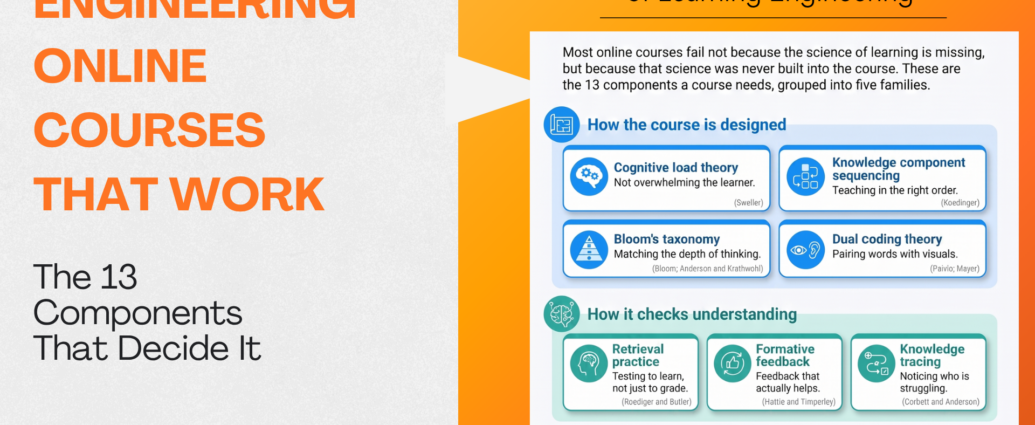
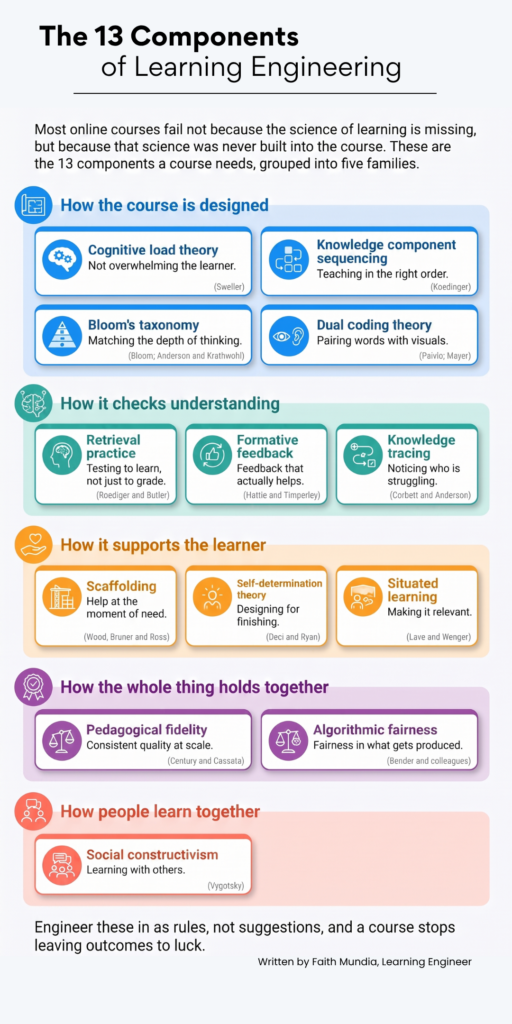
There are 13 of those things. Let me show you.
First, the real problem
Completion rates for online courses are famously brutal. Numbers below ten percent are normal, not the exception. And every single time, the same two suspects get named: lazy learners, or weak content.
But think about the courses you have quietly abandoned. It usually was not that you stopped caring. Something in how the course was built let you drift. No check to see whether you actually understood. No nudge when you went quiet. No sense that anyone else was on the journey with you.
Good learning has ingredients. Knowable ones. Each of the 13 below has a real name in the learning sciences, and a researcher whose work it comes from, so I will give you both, then say it in plain language. Most courses are missing several of these, and not on purpose. They are missing them because almost nobody sits down with the list and asks the plain question: did we actually build the conditions for learning into this thing?
So here is that list, grouped into five plain families. If you have ever built a course, or taken one that fell apart on you, you will recognise every one.
How the course is designed
This is the shape of the learning itself, before anyone even presses play.
→ Cognitive Load Theory (Sweller): not overwhelming the learner. Human working memory is small. Pile too much on at once and nothing sticks. Good courses feed ideas in at a pace a brain can actually hold.
→ Knowledge Component Sequencing (Koedinger): the right order. Concepts build on each other. Teach them out of sequence and the learner is forever standing on a step that was never laid.
→ Bloom’s Taxonomy (Bloom; Anderson and Krathwohl): matching the depth of thinking. “Remember this fact” and “use this to solve a real problem” are different kinds of learning. A course should be honest about which one it is asking for, and build toward it.
→ Dual Coding Theory (Paivio; Mayer): words and visuals together. We learn better when an explanation is paired with the right image. Not walls of text, and not decoration for its own sake.
How it checks understanding
A course that never checks is just content on a screen.
→ Retrieval Practice (Roediger and Butler): testing to learn, not just to grade. The act of pulling something back out of your memory is what makes it stick. Quizzes are not there to judge you. They are part of the learning.
→ Formative Feedback (Hattie and Timperley): feedback that helps. “Wrong” is useless. “Here is why, and here is what to look at” is where the learning actually happens. This one is old wisdom, and courses still skip it constantly.
→ Knowledge Tracing (Corbett and Anderson): noticing who is struggling. A good system pays attention. It can see where people slow down, get stuck, or quietly leave, and it does not wait for a complaint before it acts.
How it supports the learner
Building the course is not the same as holding the person through it.
→ Scaffolding (Wood, Bruner and Ross): help at the moment of need. Support that shows up right when someone is stuck, then fades as they get stronger. Not buried in a forum they will never open.
→ Self-Determination Theory (Deci and Ryan): designing for finishing. Most courses are built to be started. Very few are built to be completed. Motivation, and the autonomy and competence that feed it, have to be designed in, not hoped for.
→ Situated Learning (Lave and Wenger): making it relevant. Learning lands when it connects to the learner’s own world and context. A generic example built for somebody else’s life is very easy to tune out.
How the whole thing holds together
Quality cannot depend on luck, or on who happened to build the course that day.
→ Pedagogical Fidelity (Century and Cassata): consistent quality at scale. Great teaching should not only happen when a great teacher is in the room. The quality has to hold across every course, not just the best ones.
→ Algorithmic Fairness (Bender and colleagues): fairness in what gets produced. Especially now that AI helps generate content, someone has to check that it is not quietly carrying bias, stereotypes, or blind spots.
How people learn together
And the one almost everyone forgets.
→ Social Constructivism (Vygotsky): learning with others. We are social learners. Discussion, peer interaction, the simple feeling of not being alone in it. This is not a nice-to-have. Take it out and completion falls. It really is that direct.
Who this is for, and where it shows up
If you build online learning, for a school, a business, or your own audience, this list is really a mirror. Hold your last course up against it and the failures usually light up fast.
The reason I can lay these out so plainly is that I spent the last stretch building a platform, FayEDU, that tried to take all 13 seriously rather than picking the easy few. And building them taught me something that changed how I think about all of this. Take one small example. On that platform you cannot publish a course without a welcome video, because knowing your teacher measurably improves how people learn. And every learning unit ends in a quiz, not as a gate, but because that act of recall is where the learning sets. Small things. But they are built in, not left to chance.
The shift that changes everything
And that is the whole shift, right there.
Most platforms, most courses, most tools, hope the creator remembers good practice. They leave it up to willpower and memory. The stronger move is simpler, and a little stubborn: build the good practice in, so it cannot be skipped.
A quiz after every unit that is not optional. No publishing a course that has no welcome video. A quality check before anything goes live. None of that depends on the creator having a good day, or remembering the research. It is just there, in the walls.
Rules, not suggestions. That is the difference between a course that hopes to work and one that is built to.
Where this lands
Which is really what all of this comes down to. We license the people who build bridges. We do not let a structure carry weight and simply hope it holds. Learning deserves that same seriousness. When we engineer it, when we actually build what we know into the thing itself, we stop leaving outcomes to luck.
That is what learning engineering is. And these 13 components are where it begins.
So here is my honest question for you, and I would genuinely love your answer in the comments. Think of the last online course you gave up on. Which of these 13 was missing? 👇
I am writing my way through all 13 in this series, one idea at a time. Follow along if you want the rest.
📬 Want more insights like this?
Subscribe to Grounding EdTech and get weekly insights on AI, EdTech, and instructional design — plus free access to our Instructional Design for Educators course.
No spam. Unsubscribe anytime.