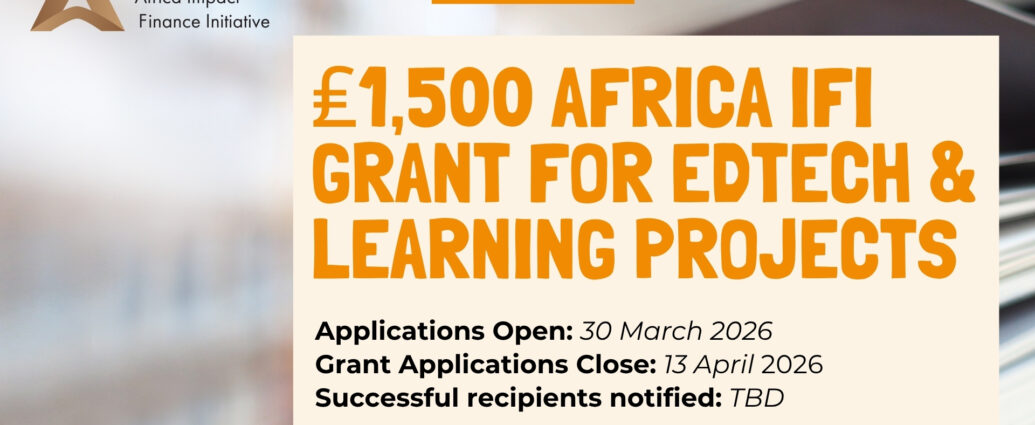
Most of the educators and EdTech builders I know who are running genuinely impactful work across Africa share one common frustration: they are not short on ideas, they are not short on commitment, and they are absolutely not short on need. What they are short on is the small, flexible, no-strings-attached money that keeps community-level work alive while they build toward larger funding. The Africa IFI Grant 2026 is exactly that kind of money. And the application deadline is 13 April 2026.
I want to be direct with you: this is a small grant. £1,500. But I have seen what the right £1,500 at the right moment does for the right project. If you are running a community learning hub, a digital literacy programme, an after-school initiative, or a vocational training effort for young people in Africa, this grant was written for you. The question is not whether you qualify. The question is whether you will apply before time runs out.
The funding is out there. The problem is that most founders never hear about it in time. You are hearing about it now.
| KEY DATES — ACT NOW. Application Deadline: 13 April 2026 Award Amount: £1,500 per organisation Notification: Shortly after the deadline closes Apply at: https://www.africaifi.org/grant |
Who This Is Really For, and Honest Context on Fit
Let me give you the honest picture before you invest time in an application.
The Africa IFI Grant is designed for grassroots, community-based organisations, not for established institutions with dedicated grants teams or for platform-stage startups seeking growth capital. This is a deliberately low-barrier opportunity built for the kind of work that is too locally embedded, too practically focused, or too small in scale to fit neatly into most major donor portfolios. That is precisely why most of those organisations will not hear about it.
| ELIGIBILITY AT A GLANCE✔ Based on the African continent✔ Operational for at least 12 months✔ Clear education mission serving children or young adults up to age 25✔ Organisational form: community trust, registered NGO, CBO, or consistently active informal group✔ Direct, embedded service to the community you are based in Not required: formal registration in a specific legal category, previous grant experience, or large-scale operations. |
The twelve-month operational requirement is real, and it matters. The grant is specifically not for brand-new initiatives. What it is looking for is evidence that you are already embedded in your community and that your work has a track record, however modest. If you have been running for over a year, consistently showing up for the young people you serve, that track record is your strongest asset in this application.
On competitiveness: I cannot give you exact odds, but I can tell you what consistently determines success in small operational grants like this one. It is rarely the most ambitious proposal. It is the clearest one. The organisation that can articulate, in simple, specific language, exactly what the money will do and exactly who it will reach. Small grants committees are not looking for vision statements. They are looking for confidence that the money will actually be used.
If your work directly serves young people in Africa and you have been doing it consistently for at least a year, this is a strong fit. Do not talk yourself out of applying because your organisation feels too small. That is exactly who this grant was designed for.
What Makes a Strong Proposal, and What Quietly Sinks One
I have spent time on both sides of the funding desk. Here is what I have seen consistently separate the applications that receive funding from the ones that do not, particularly in small, operationally-focused grants at this level.
What reviewers are actually looking for:
- A specific use of the money. Not ‘we will use it for operational costs’, but ‘£1,500 will cover three months of internet connectivity for our 40-learner digital literacy hub in Kisumu, allowing us to run four sessions per week without interruption.’ The specificity signals that you have actually thought this through and that the money has a clear, accountable destination.
- Evidence of community embeddedness. Numbers are useful. How many young people you serve, how often, over how long. But the texture of the relationship matters too. Reviewers are looking for organisations that are genuinely of the community they serve, not just operating within it. If community members are involved in running, designing, or facilitating your programme, say so explicitly.
- A realistic, honest budget. £1,500 is a specific amount. A proposal that maps every pound to a specific expenditure, with costs that are clearly locally contextualised, reads as competent and trustworthy. A vague budget reads as an organisation that has not yet thought carefully about implementation.
- Clarity about who you serve. Age group, community context, and the specific barriers your learners face. Not a demographic summary, a genuine picture of who is in the room when you do your work and why they need the support you are providing.
What quietly sinks a good application:
- Opening with your organisational history before establishing the community need. Lead with the problem and who it is affecting, then explain who you are and why you are positioned to address it.
- Using language that describes ambition rather than activity. ‘We aim to transform digital literacy’ is a vision statement. ‘We run two weekly digital skills sessions for 35 young women aged 16–24 in Nakuru’ is evidence of work.
- A budget that does not add up or that does not match the proposal narrative. Check every line. Inconsistencies in the numbers signal disorganisation, even when the underlying work is solid.
- Underselling your track record because you feel your organisation is ‘too small.’ Twelve months of consistent, embedded community work is significant. Own it.
Before you start writing your application:
Download our proposal framing guide at groundingedtech.fayedu.com. It walks you through the four things every strong small-grant application needs to establish in the first two paragraphs. Use it before you write a single word of your Africa IFI submission.
What £1,500 Actually Does at Community Scale, and Why That Matters
This is where I want to push back gently against the instinct to dismiss a small grant. In community-based education work in Africa, £1,500 used with focus and intention can do any one of the following things in full:
- Cover three to four months of internet connectivity for a 30–50 learner digital hub running daily sessions, removing the single most common reason community digital literacy programmes collapse mid-delivery.
- Purchase four to six low-cost learning devices (tablets or Chromebooks) for a shared community lab, transforming a programme that currently has learners waiting their turn into one where everyone can participate simultaneously.
- Fund a six-week skills-building workshop for young adults, including facilitator stipend, printed materials, and transport support for participants, from start to finish.
- Stock a community library or homework club with curriculum-aligned books and learning materials for a full academic year.
- Cover facilitator training costs to upskill two or three local educators, building internal capacity that outlasts the grant itself.
I want to be clear about something the original grant description mentions but undersells: this grant is not just about the £1,500. It is about what successfully securing and managing a small grant does for your organisation’s future. Every grant you win, including a small one, is a data point that larger funders look at. It is evidence that you can write a coherent proposal, manage a budget, and deliver on a commitment. The organisations I have seen grow into mid-size funding relationships almost all started with exactly this kind of operational grant. It built the track record that the next conversation required.
This grant is not just money. It is a stepping stone, and for the right organisation, it is the exact next step.
What a Well-Matched, Well-Executed Application Looks Like
Consider an organisation like this, and you will recognise the type immediately if you have been working in community education in Africa. A CBO running after-school digital literacy sessions for 45 young people aged 14–22 in a peri-urban neighbourhood. Operational for two years, funded initially through a church’s discretionary budget and a few individual donations from community members. They have a dedicated facilitator who gives two afternoons a week. Their biggest operational challenge: the internet dongle they use for sessions runs out of data by the third week of every month, and the last week of each month becomes a paper-based session that the learners, the ones who came specifically for digital access, disengage from.
Their Africa IFI application is three pages. It names the 45 young people clearly — who they are, what barriers they face, and why digital literacy matters specifically for their post-school opportunities. It explains the data problem with specificity: four months of reliable connectivity at local rates, costing £320, solves the month-end gap for the rest of the grant year. The remaining £1,180 covers printed reference materials, one facilitator skills day, and a small reserve for unforeseen session costs. The budget adds up to the penny.
This is not a glamorous proposal. It is not proposing to scale, to pilot a new AI tool, or to build anything particularly novel. It is proposing to do existing good work consistently, without the interruption that funding gaps cause. That clarity and that modesty is exactly what make it strong.
When you write your application, think about that CBO. Not the ambition. The specificity. Not the vision. The people in the room.
Here Is the Link, Here Is the Deadline, Here Is Your First Step
You have eleven days. That is enough time to write a strong application if you start today, and not enough time to leave it until next week. Here is exactly what to do:
- Confirm your eligibility right now. Africa-based ✔ | Operational 12+ months ✔ | Education mission serving under-25s ✔ | If all three, proceed immediately.
- Draft your budget before you write a single word of the narrative. List every specific thing £1,500 will fund. Attach local costs to each line. Make sure it adds up. The budget is the spine of the proposal; write it first.
- Visit www.africaifi.org and click ‘Apply Now’. If you encounter a 404 or broken link on the grants page, return to the main homepage and look for the grant announcement banner. The portal will be active from the opening date. Do not let a temporary technical issue stop your application.
- Write four things clearly in your proposal. Your organisation and mission. Who you serve (be specific; age, community context, what barriers they face). Your current programme and what it delivers. And a specific, simple plan for exactly how £1,500 will sustain, grow, or stabilise your work.
- Submit before 13 April 2026, and aim for several days early. Early submission gives you time to resolve any portal issues and signals organisational competence. Do not schedule yourself for the final 24 hours.
And if this opportunity is not the right fit for your organisation right now, share it. The educator in your network is running a homework club on a shoestring. The CBO facilitator does not know where to look for this kind of funding. The youth vocational programme has been operational for two years and has never applied for anything. Send them this article. The deadline is 13 April.
Great Work Does Not Fail Because It Is Not Good Enough
It fails because it does not reach the right people at the right time. That is the thing I come back to every time I surface an opportunity like this one. The Africa IFI Grant is small by the standards of most institutional funders. It is significant by the standards of most community-based education work in Africa. And the gap between those two measures is exactly where most of the continent’s best grassroots programmes live, doing essential work, chronically underknown by the people who could fund it.
Closing that gap is what Grounding EdTech’s opportunities series exists to do. And if you are building something at the intersection of EdTech and community impact, at the platform level, at the policy level, or anywhere in between — the funding landscape that shapes what is possible for you is shifting. Scott Portico has the policy and compliance dimension of that shift covered in his latest piece; Faith Mundia has the platform strategy angle. The opportunities in this space are real. The window to access them is always shorter than you think.
Your idea deserves funding. Sign up for opportunity alerts and never miss a deadline again groundedtech.fayedu.com.
| APPLY BEFORE 13 APRIL 2026 Grant: Africa IFI Grant 2026 Amount: £1,500 Who: Africa-based education organisations, 12+ months operational, serving under-25s Apply at: https://www.africaifi.org/grant Not ready to apply? Share this article with someone who is. |
📬 Want more insights like this?
Subscribe to Grounding EdTech and get weekly insights on AI, EdTech, and instructional design — plus free access to our Instructional Design for Educators course.
No spam. Unsubscribe anytime.